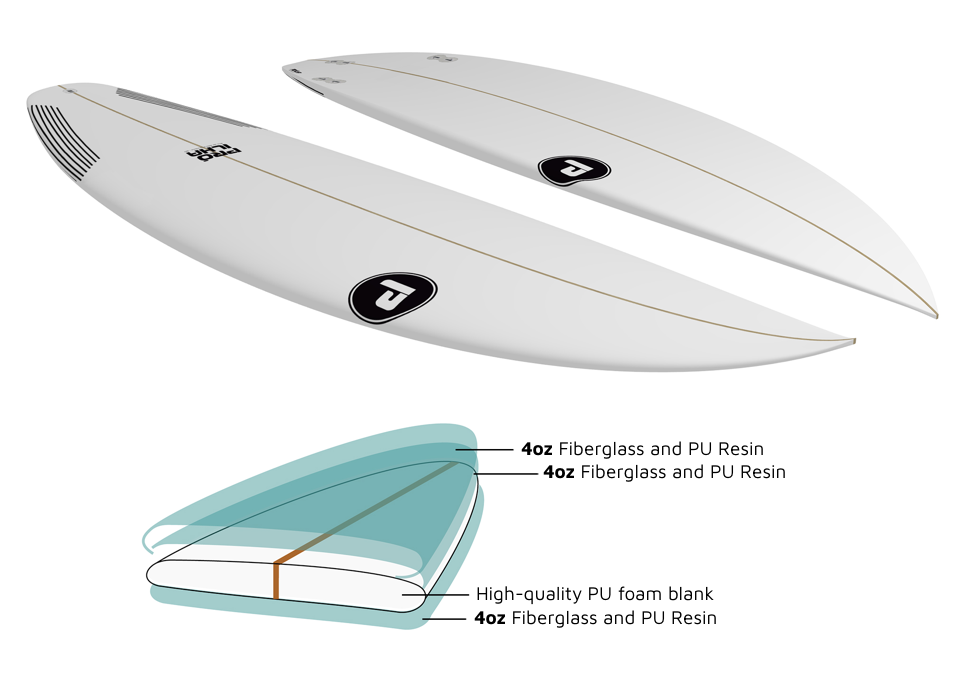
This is a technology we have known for years and is the global standard. The boards are made from polyurethane (PU) foam blanks with a stringer, laminated with fiberglass cloth and polyester resin. The blanks we use are imported and of the highest quality. The lamination consists of 1 layer of 4oz fiberglass cloth on the bottom + 2 layers of 4oz cloth on the deck. The fabrics used are imported Hexcel and JPS. A UV inhibitor and optical brightener are added to the polyester resin to make the boards even whiter.
This technology is excellent for everyday use and delivers great performance in all types and sizes of waves and for all skill levels, from beginner to competitor.
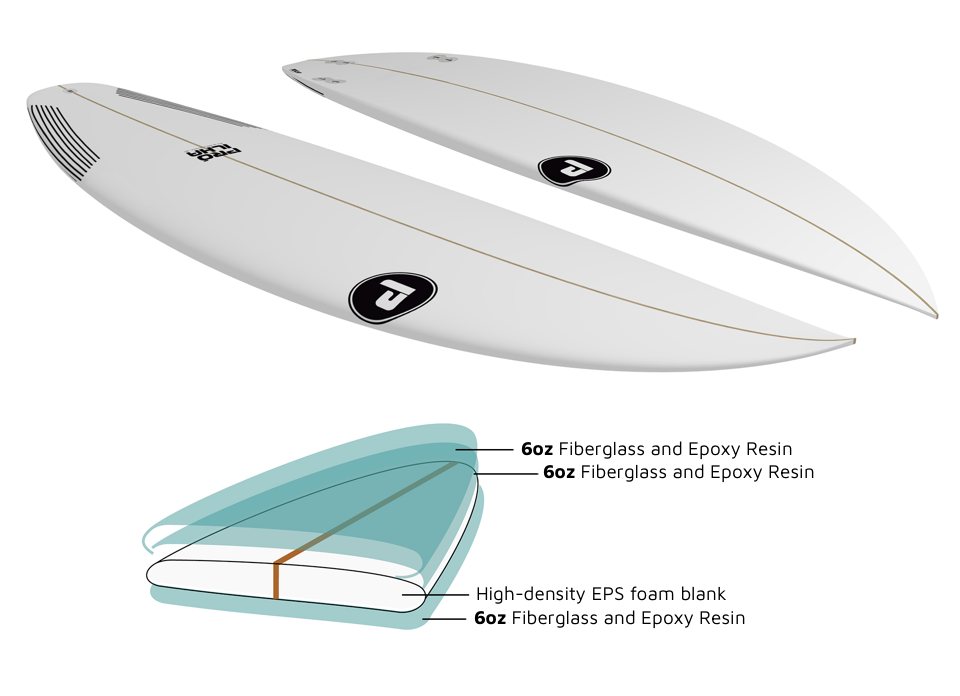
EPS stands for Expanded Polystyrene, and for this technology it is standard for boards to be produced using EPS foam blanks with a stringer, laminated with fiberglass cloth and epoxy resin. We only use molded blanks, ensuring both lightness and strength. The lamination consists of 1 layer of 6oz fiberglass cloth on the bottom + 2 layers of 6oz cloth on the deck. The resin stands out for its ultra-white finish and very low yellowing over time.
EPS boards are known for having stronger lamination and a lighter core, as well as offering slightly more buoyancy compared to PU boards. They are recommended for everyday small to medium waves.
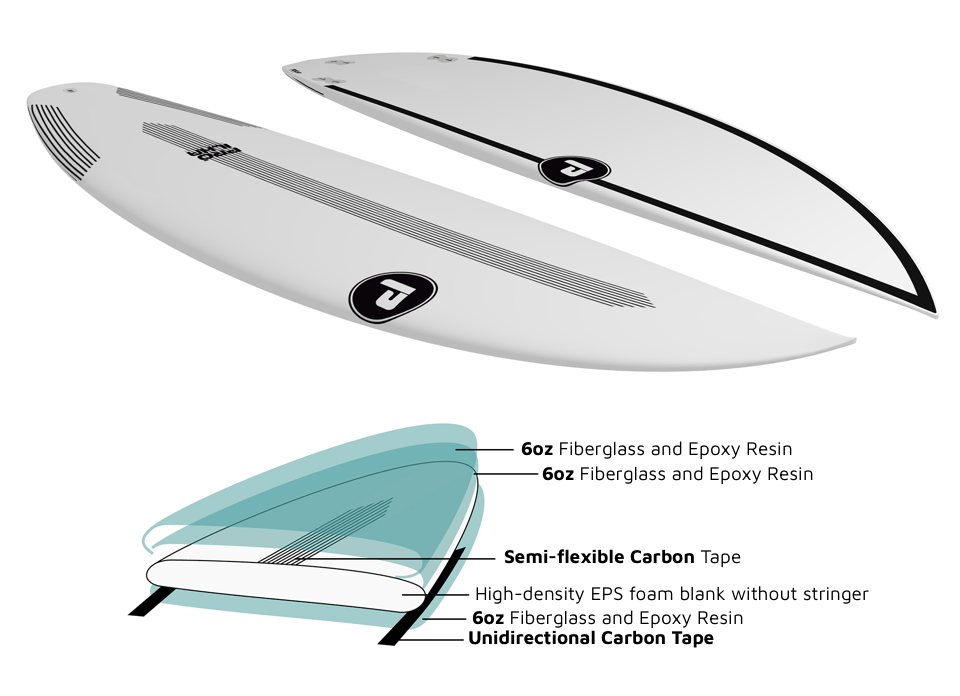
Also built with EPS and epoxy resin, the highlight of Carbon Sling boards is the absence of a stringer and the carbon reinforcement details on the deck and bottom. This results in a different flex pattern, providing more drive in the wave and a faster response.
The lamination consists of 1 layer of 6oz fiberglass cloth on the bottom + 2 layers on the deck, 4oz and 6oz. The resin stands out for its ultra-white finish and very low yellowing over time.
In addition to the advantages of EPS being lighter and stronger, the Carbon Sling system also provides more energy to the board, resulting in improved performance in small and choppy everyday waves.
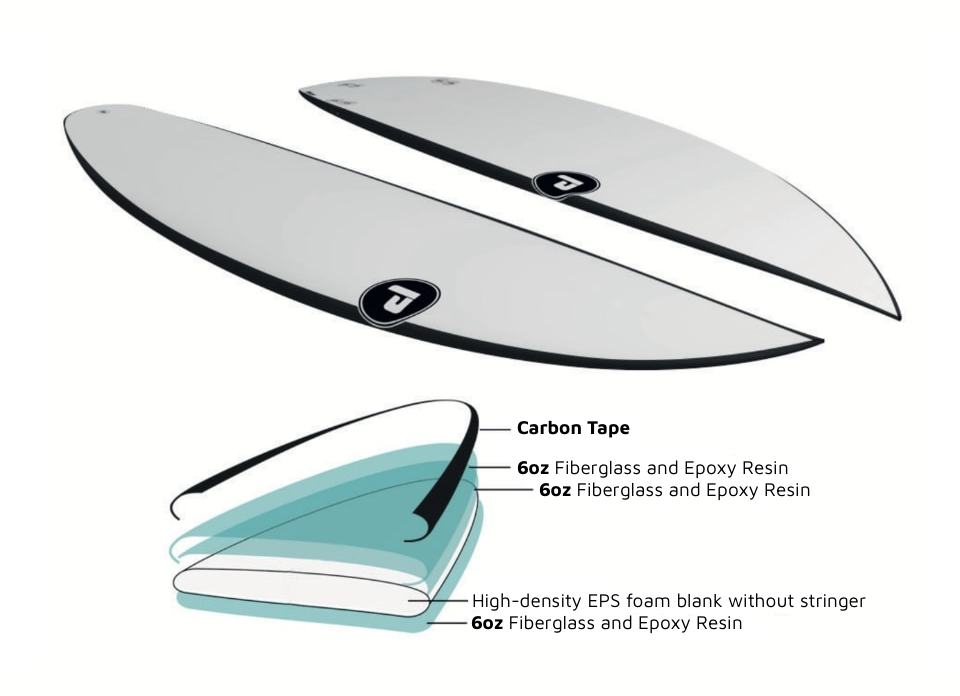
Following the Carbon Sling line, these boards are also built with EPS and epoxy resin, featuring no stringer. The key difference in this model is the continuous carbon reinforcement from rail to rail, on both the deck and bottom (nose to tail). This results in a combination of flexibility and strength, delivering faster response in the surf.
The lamination consists of 1 layer of 6oz fiberglass cloth on the bottom + 2 layers of 6oz cloth on the deck. The resin stands out for its ultra-white tone and very low yellowing over time.
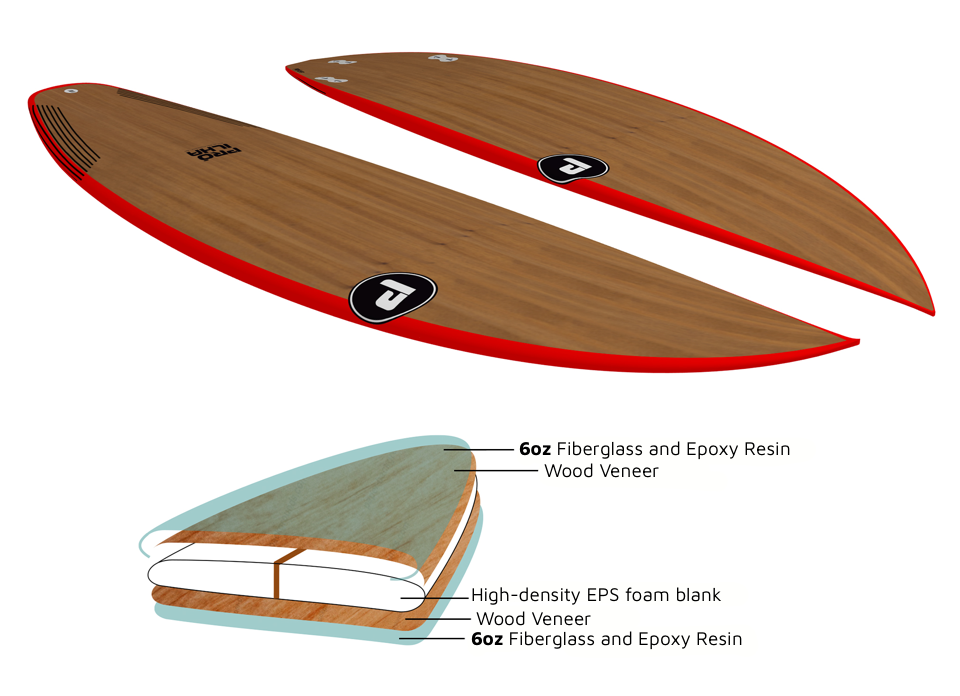
Vacuum Wood boards stand out for being lighter, stronger, and for their wood aesthetic. The boards are built using EPS foam blanks with a stringer, laminated with fiberglass cloth, epoxy resin, and a wood veneer on both the deck and bottom. To bond these three materials, the blank is laminated using a vacuum system and kept under 800 kg of pressure for 8 hours. This creates a fusion between the materials, resulting in a board that can be up to 30% lighter than a standard PU board. Additionally, the wood veneer replaces several layers of fiberglass, making the board even more durable.
The finish is done with polyester resin, either matte or polished, depending on preference. Another key feature is that the rail paint is applied internally, protected by fiberglass and resin, making it more durable as well.
IMPORTANT: For all technologies, the blanks are machined using 3D shaping machines (APS 3000 and Aku Shaper 3D), based on the design developed by the shaper in the software, following the specifications for bottom curves, outline, concaves, rails, and foil. The shape comes out about 90% complete, and the shaper then refines it by hand. The machine delivers precision and greatly contributes to consistency, fine-tuning, and alignment with the surfer's needs.
In addition, Pró-Ilha has a team of 25 employees, most of whom have over 10 years with the company, and some with more than 25 years. It is important to highlight that skilled craftsmanship is essential for the board's performance and durability, thanks to the team's commitment to achieving the highest quality.